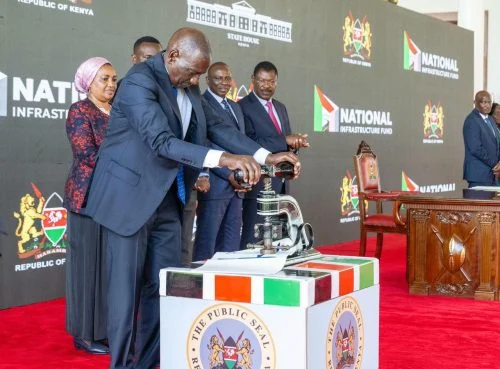
President William Ruto signed the County Allocation of Revenue Bill, 2026, into law on Monday, June 29, 2026. The signing ceremony took place at State House, Nairobi.
This enactment officially unlocks Ksh 428 billion for Kenya’s 47 county governments as their equitable share of nationally raised revenue for the 2026/2027 financial year.
Here are the key details about the bill and its provisions:
The bill, sponsored by Mandera Senator Ali Roba, was published on March 30, 2026. It was passed by the Senate with amendments on June 17 and subsequently approved by the National Assembly without further changes on June 25. Following approval by both houses, it was presented to the President for assent.
This allocation represents 20.9% of the most recently audited national revenue, exceeding the constitutional minimum requirement of 15%. The Ksh 428 billion marks a Ksh 13 billion increase from the Ksh 415 billion allocated in the previous financial year.
The funds are distributed using a formula based on equal share, population, poverty level, and geographical size. The breakdown is as follows:
Baseline Allocation (Ksh 387.43 billion): Supports the day-to-day operations and development programs of all county governments.
Affirmative Action Allocation (Ksh 4.46 billion): Specifically benefits 12 historically marginalized counties to help bridge development gaps.
Weighted Formula Allocation (Ksh 36.1 billion): Shared using a formula that considers population, poverty levels, income distance, and geographical size, ensuring counties with greater needs receive additional support.
The legislation provides the legal framework for the disbursement of funds to counties for the upcoming financial year. Its key provisions include:
Strengthening Devolution: By providing counties with the resources needed to deliver essential services like healthcare, agriculture, roads, water, and early childhood education.
Enhancing Accountability: County executives must determine the cost of transferred functions, while national government entities taking over devolved functions must submit quarterly reports to the Senate and relevant County Assemblies.
Setting Budget Ceilings: The Act sets budget ceilings for recurrent expenditure to ensure a balance between day-to-day operations and development spending.
Ensuring Transparency: The Cabinet Secretary for the National Treasury is required to publish monthly reports on transfers made to counties.
The timely enactment allows counties to finalize their budgets before the start of the new financial year. Some of the counties receiving the largest shares include Nairobi (Ksh 22.1B), Nakuru (Ksh 14.9B), Turkana (Ksh 14.3B), Kakamega (Ksh 14.1B), and Kiambu (Ksh 13.5B)
📄 Disclaimer
This article is based on publicly available information from official government communications, project reports, and credible media sources. While every effort is made to ensure accuracy, project details such as timelines, costs, and implementation status may change over time.