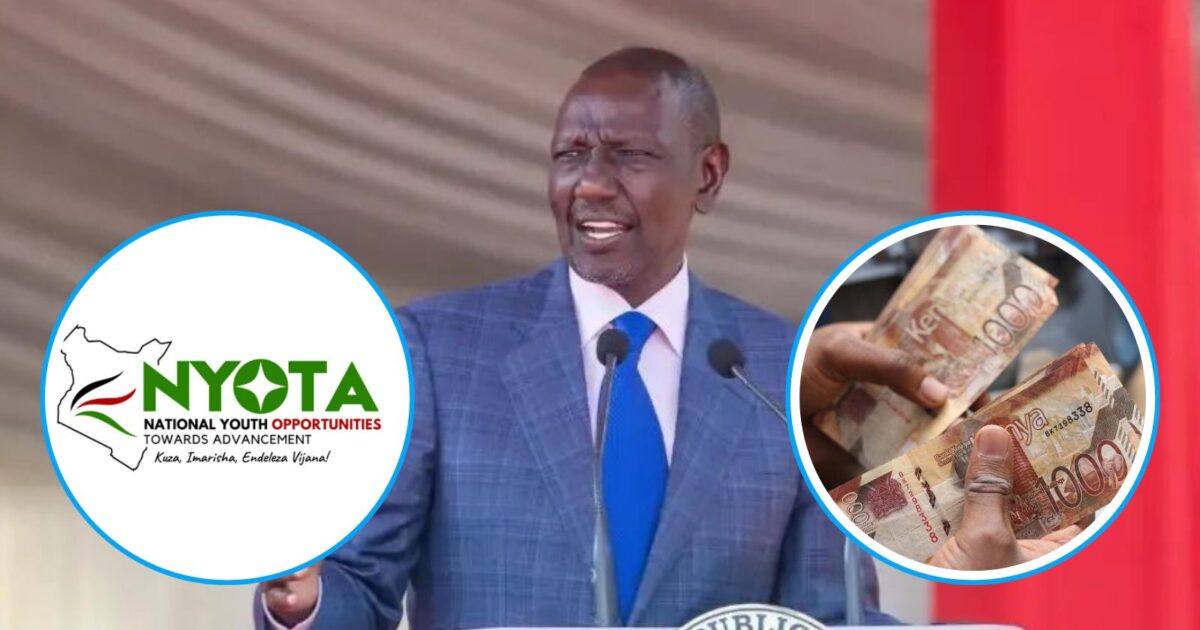
President William Ruto has announced a major financial boost for thousands of citizens across the nation. A total of 122,000 Kenyans are set to receive Ksh25,000 each under the second tranche of the government’s Nyota Programme.
This development, reported on July 6, 2026, marks a significant milestone in the state’s ongoing social-economic support initiatives. The rollout of this second phase highlights the administration’s commitment to direct resource mobilization for citizens.
Under this specific tranche of the Nyota Programme, the government will disburse a cumulative sum of Ksh3 billion. Each of the 122,000 verified beneficiaries is expected to receive their Ksh25,000 allocation directly to facilitate ease of access. When combined with the earlier disbursement made earlier this year, each beneficiary will have received a total of Ksh50,000 in business support.
The second phase of the NYOTA Business Support programme is set to kick off from Friday, July 10, 2026. The nationwide launch will take place simultaneously at 18 venues across the country, bringing together beneficiaries drawn from all 47 counties.
All beneficiaries earmarked for the second disbursement have successfully completed mandatory business development skills training ahead of receiving the second round of funding.
The NYOTA initiative is jointly funded by the Government of Kenya and the World Bank and is designed to expand economic opportunities for young people through enterprise development, skills training and employment.
The programme’s initial rollout earlier this year saw Ksh250 million distributed to 9,500 young entrepreneurs across six counties in the North Rift region (Turkana, West Pokot, Trans Nzoia, Nandi, Uasin Gishu and Elgeyo Marakwet). When unveiling the programme in January, President Ruto said it had an overall budget of Ksh5 billion and targets 100,000 young people across the country, with at least 70 beneficiaries selected from each of Kenya’s 1,450 wards.
Programme Components
The NYOTA programme is structured around four key components:
Paid on-the-job training for 90,000 young people
Entrepreneurship support (business start-up capital)
Recognition of Prior Learning (RPL) certification for 20,000 youths
Business training to enable 600,000 young people to access government procurement opportunities
The Nyota Programme has emerged as a crucial safety net under the current administration. By transitioning into the second tranche, the government seeks to expand its reach and cushion more households from pressing economic pressures.
While the exact disbursement timelines and specific channels are being finalized, the focus remains on ensuring transparency and efficiency. The state aims to deliver these funds directly to the identified recipients without unnecessary bureaucratic delays.
The Nyota Programme’s second tranche represents a scaled-up effort by the government to ensure financial inclusivity. As the state machinery moves to execute the payouts, the focus shifts to the positive economic impact these funds will have on local communities.
This latest announcement has sparked widespread interest across Kenya, with many citizens tracking the progress of the Nyota Programme. The initiative continues to be a central pillar of President Ruto’s grassroots economic empowerment agenda.
| Item | Detail |
|---|---|
| Beneficiaries | 122,000 young Kenyans |
| Amount Per Beneficiary | Ksh25,000 (second tranche) |
| Cumulative Total Per Beneficiary | Ksh50,000 (including first tranche) |
| Total Government Allocation | Ksh3 billion |
| Programme Name | National Youth Opportunities Towards Advancement (NYOTA) |
| Launch Date | Friday, July 10, 2026 |
| Launch Venues | 18 simultaneous venues across all 47 counties |
| Funding Partners | Government of Kenya and World Bank |
| Overall Programme Budget | Ksh5 billion |
| Target Beneficiaries | 100,000 young people across 1,450 wards |
| First Phase | Ksh250 million to 9,500 entrepreneurs in 6 North Rift counties |
📄 Disclaimer
This article is based on publicly available information from official government communications, project reports, and credible media sources. While every effort is made to ensure accuracy, project details such as timelines, costs, and implementation status may change over time.