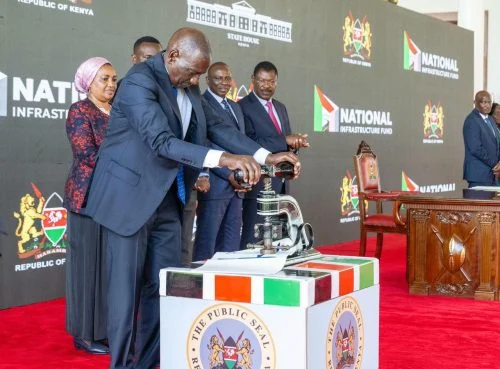

NAIROBI — President William Ruto has officially signed the Sovereign Wealth Fund Bill, 2026, into law, marking a major milestone in the country’s economic governance.
The signing ceremony, which took place on Wednesday, July 8, 2026, at State House, Nairobi, introduces a structured approach to managing Kenya’s national wealth by separating savings for future generations. The event was attended by senior government officials, Members of Parliament, and schoolchildren—a symbolic presence representing the law’s commitment to future generations.
This new law represents a significant shift in how the nation handles its financial resources. By establishing a sovereign wealth fund, the government secures a legal mechanism to safeguard national assets for the long term. The Act establishes three distinct sub-funds:
- Future Generations Fund (Urithi Fund): Dedicated to preserving wealth for future generations. This is the most protected component, with strict prohibitions against borrowing against it or using it as collateral.
- Stabilisation Fund: Designed to cushion the country during economic downturns, pandemics, natural disasters, and other external shocks.
- Strategic Infrastructure Investment Fund: Aims to finance priority national development projects like roads, railways, energy, and water projects, often by pulling resources from the private sector.
The primary objective of this legislative framework is to ensure fiscal sustainability. The structured approach outlined in the law will govern how the state allocates, invests, and preserves its revenues. At least 30% of all revenue from Kenya’s petroleum and mineral resources will be set aside for the Future Generations Fund.
By separating savings for future generations, the policy ensures that current resource gains are not entirely consumed today. Instead, a portion of the national wealth will be preserved to support Kenyans in the years to come. The fund will also be financed through designated government revenues, investment income, grants, donations, and other sources approved under the law.
To protect public resources, the Act places strict limits on how the fund can be invested. It prohibits investments in:
-
- Speculative derivatives
- Unlisted securities
- Real estate located in Kenya
- Private equity
- Art and commodities
- Securities issued by Kenyan entities
The fund will be managed by a board chaired by a person appointed by the President, with members including the Cabinet Secretaries for the National Treasury, Mining, and Petroleum, along with four competitively recruited professionals. The fund’s investment policy will require approval from the National Assembly, and the fund will operate under the Public Finance Management Act and other relevant laws.
For a long time, governance experts have debated the necessity of such a fund to cushion the country against global economic volatility. With the President’s signature, Kenya now joins other global economies that utilize sovereign funds to secure their economic sovereignty. President Ruto explicitly cited Norway as the model Kenya had drawn from, pointing to its sovereign wealth fund which has grown to roughly Ksh 280 trillion over three decades.
“We have not yet discovered oil, gas, or other minerals on a commercial scale in Kenya, but we have seen what happens in other countries. We are putting the legal framework in place before the temptation to misuse those resources arises,” President Ruto said during the signing ceremony.
He noted that significant mineral deposits have been confirmed across the country, including niobium, rare earth elements, gold, and coal.
The enactment of this bill is a crucial step for the presidency and the country’s financial sector. It provides a clear roadmap for wealth preservation, ensuring that the management of public funds aligns with international best practices. President Ruto further stated that profits from national investments, including the ongoing JKIA upgrade project, would also feed into the fund. He plans to use the fund to effect a Ksh 5 trillion development project within 10 years.
As the new framework takes effect, the government is expected to establish the administrative structures required to run the fund. This will determine how the savings are invested to maximize returns.
The focus now shifts to the practical execution of this law. Public financial experts will be watching closely to see how the structured approach is implemented to achieve the goal of protecting Kenya’s national wealth.
Reactions and Context
The signing of the bill has drawn mixed reactions from experts and the public. Some economists have welcomed the move as a forward-thinking step that will safeguard Kenya’s future against economic volatility. Others, however, have expressed concerns about the implementation, calling for transparency and accountability to ensure the fund does not become another avenue for corruption.
International financial institutions, including the World Bank, have been closely monitoring the process. The enactment aligns Kenya with global best practices, following in the footsteps of countries like Norway and Botswana, which have successfully used sovereign wealth funds to transform their economies.
📄 Disclaimer
This article is based on publicly available information from official government communications, project reports, and credible media sources. While every effort is made to ensure accuracy, project details such as timelines, costs, and implementation status may change over time.